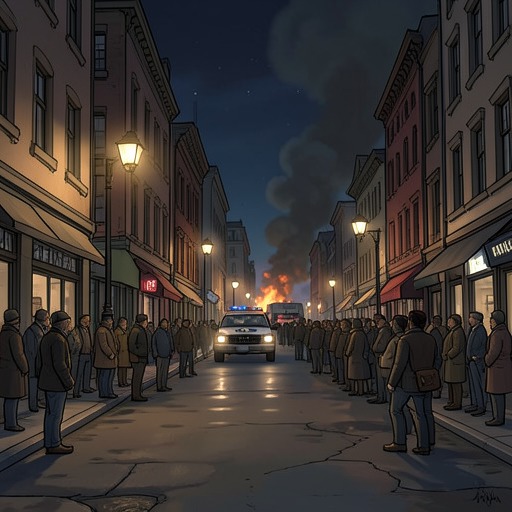
Garden Heights police shooting of a teenager and ensuing riots
On the Come UpThe Garden Heights police shooting of a teenager and the ensuing riots and protests form a defining rupture in the neighborhood’s recent history. The teenager was unarmed, yet a grand jury declined to charge the officer; in the aftermath, local businesses were destroyed, police presence became part of daily life, and fear of violence expanded from conflicts between neighborhood groups to encounters with law enforcement.
The Shooting and the Riots
The shooting occurred a few streets from Brianna Jackson’s grandparents’ home. The boy was unarmed, but the grand jury decided not to charge the officer. Riots and protests continued for weeks. The narrative presents the decision not as closure but as a turning point: the community’s grief and anger remain visible in the disorder that follows and in the altered conditions of everyday life.
Half of the businesses in Garden Heights were either deliberately burned by rioters or caught up in the destruction. Club Envy, previously the usual Thursday-night gathering place, was among the casualties. Jimmy’s became an alternative setting for the post-battle gathering known as the let out, while the damaged neighborhood continued to carry the consequences of the unrest.
A Neighborhood Under Watch
After the riots, police cars repeatedly drive through the neighborhood. Their presence is presented as a new normal, ostensibly framed as friendly reassurance but experienced by Brianna as surveillance directed at Black residents. Ordinary scenes—neighbors tending flowers or taking out trash, cars playing music—look familiar, yet the neighborhood no longer feels as safe as it did before.
That change alters the risks residents perceive. Before the shooting, Brianna says she worried about the Garden Disciples and the Crowns; afterward, police become another source of fear. Her mother, Jayda Jackson, describes the shooting’s injustice through the image of a stranger taking someone’s child and then blaming the family, while the wider public judges its grief. The comparison captures how the event’s harm extends beyond the death itself: it includes the public denial of the family’s and community’s right to mourn and protest.
From Neighborhood Violence to School Security
The unrest also shapes the schools’ response. At Midtown School of the Arts, metal detectors and security checks are already part of the daily routine. Brianna passes through the detector without setting it off, but Officer Long blocks her and orders her back; Officer Tate backs the order without giving a substantive reason. When she resists being handled, Long restrains her and Tate removes her backpack. The incident makes the broader climate of suspicion concrete in a school procedure applied to a student who has not triggered the detector.
The school’s response leaves the question of unequal treatment unresolved. Principal Dr. Rhodes promises an investigation and says disciplinary action may follow, while asking Brianna whether she has been selling candy on campus. Jayda objects that her son had previously told her guards singled out certain students, and rejects the suggestion that her children are inventing their account. Dr. Rhodes maintains that the guards treat all students alike. The clash between the family’s testimony and the administration’s assurance mirrors the broader dispute over whose account of safety and harm is accepted.
Lasting Consequences
School security escalates further in the aftermath of the student uprising: students are arrested, guards are hospitalized but expected to recover, and students are sent home while officials consider what to do next. At a public meeting, a parent questions metal detectors, random pat-downs, and armed police, saying the school is not a prison. Superintendent Cook justifies heightened security by citing recent crime spikes in the area, but does not explain the presence of armed officers. The response leaves the community to infer why those measures have arrived.
The shooting’s effects also reach the material life of the neighborhood. The church daycare is damaged during the riots, and the insurance company refuses to cover the repairs. Christ Temple’s pastor and elders adjust the budget and dismiss Jayda, adding lost income to a family already struggling with gas, rent, and food. Thus the event’s aftermath persists not only as fear and increased security but as damaged community services and household hardship.
Significance
The episode links public protest, economic damage, and institutional suspicion without treating them as separate problems. The grand jury’s refusal to charge the officer is followed by weeks of unrest; the unrest damages gathering places and services; and the security response brings police and surveillance into schools. For Brianna, the result is a neighborhood where the boundary between protection and threat has become difficult to trust, and where the consequences of the shooting continue to shape daily movement, family stability, and students’ treatment.